Saturday, October 29, 2011
Have reusable grocery bag . . .


Monday, October 24, 2011
Burning Questions


And then there is the burning question of today's Russia: "Have you paid your mobile phone bill?"
Pumpkins!

Friday, October 21, 2011
This Week from the Archives
“The Council of Ministers of the RSFSR and Gosplan [State Planning Agency] of the RSFSR reported that to decrease the plan for procurements of popping corn for 1964 is not recommended because the existing level of production does not satisfy the population's demand for foods prepared from these varieties of corn.”
The Soviet people demanded more popcorn! That is all.
The Soviet people demanded more popcorn! That is all.
Thursday, October 20, 2011
__Elena__
The film, Zviagintsev's Elena, about which I wrote briefly a few posts back, has stayed on my mind, so I've decided to try to explain it more thoroughly.
I said before that it was not entertaining per se, but instead thought-provoking and troubling. Despite its quotidian subject matter, or perhaps because of it, I found it disturbing. Each major character lives a life with which the viewer can easily identify. That said, they are real in some way, rather than being types or stereotypes. Each, in order to "just get by" is compromised or, rather, has made some choice which compromises them: Each chooses depend on someone else out of a sense of either helplessness - or entitlement. They exploit their relationships, and the power imbalances within them, to achieve what they want, rather than working to achieve a balance that is mutually beneficial and supportive.
The central characters are Vladimir, a wealthy businessman of some sort, somewhat past 60, and his wife, Elena, somewhat younger. They met when he was a patient in a hospital, appendicitis if I remember correctly, and she - a nurse. They have been together for approximately ten years, married for a rather shorter time, and each has a child--now an adult--from a previous marriage.
As I was watching the film, I considered that perhaps Katya, Vladimir's daughter, was the potential exception, the character who, despite superficial appearances, defies to the above characterization. Now I'm certain that it fits her as well. She plays her father expertly, as only daddy's girl can. At the same time, there's a something in her expression, speech, and body language that suggests that she despises him for the very thing that gives their relationship any footing at all, his unquestioning provision of anything material she requests. She despises him in a way, I think, a person can only despise one to whom they owe a debt. Thus Katya's compromise; she craves independence from her stern but doting father, but she depends on his money--and the expectation of his inheritance.
However, we also see her relationship to Elena, her ostensible step-mother. Elena feels acutely Katya's haughty sense of superiority based on class, education, wealth, and status. Katya is rude and dismissive, and Elena returns the favor by denouncing her to her father as a spoiled brat, to whom he has never denied anything.
Concomitantly, Elena's relationship with Vladimir is another compromise. Whatever the conditions and nature of their relationship in the past, it is now a sort of dystopian sort of world-turned-inside-out. He needs (or rather, has) not a wife, but a maid, cook, and nurse. They have a sexual relationship, but there is little warmth between them. In fact, the film's first line of dialogue sets the tone. Him, to her, over the breakfast that she prepares him daily: "The oats are good." Each of those aforementioned roles she plays while occupying her own modest bedroom at the other end of their otherwise opulent apartment in a posh Moscow neighborhood. Her material needs are met, but it is very clear that her emotional ones are anything but fulfilled.
Vladimir, on the other hand, retains all power, not the least of which are control over finances and the right to a wandering philanderer's eye, evidenced by his ogling of a woman in the gym just moments before the heart attack that, after some twenty-five or thirty minutes of growing tension and sparse and therefore effective movie-score strings, sets the plot in motion.
Thus he has made his choices: he has made her dependent on him financially, while being dependent on her to care for him both before, and most certainly after, the heart attack incapacitates him. He has also made his choices. Moreover, he professes that he refuses to help her son out of "tough love" toward Sergei, regardless of his willingness to provide anything for Katya. Eventually, he contemplates reserving not half of, but his entire estate for Katya in a petulant attempt to keep her son and his family away from his wealth.
And then there is the son himself, Sergei. And his own wife, son, baby, and, as we learn, a third child soon-to-be. They are as close as Zviagintsev comes to allowing himself stereotypes. However, as far as I am aware, Russian film has thus far little portrayed their type and so it has somehow avoided becoming trite, cliched. They are, in an attempt to place them in American terms, urban white trash.
Early in the film, we watch Elena leave the marbled halls of the tower in which she is caged. She collects her modest state pension and journeys far beyond the edges of Moscow to the post-industrial wasteland in the shadow of a power plant where their apartment is situated. She delivers the stash of rubles (and a bag of groceries bought on Vladimir's dime) into the hands of Sasha, who pockets a little for cheap beer and gives the rest to his wife for the provision of food. This portrays their poverty, the class divide between the Vladimir and his wife, and the physical decay of the post-Soviet Russian reality for those beyond Moscow's glitter and glam. It also serves to demonstrate Sergei's helpless but entitled dependence on troubled, even desperate, yet comfortable Elena.
But they want more from Vladimir, whom they hardly know, and who cannot tolerate the thought of helping "others." What Sergei and his tragically overstretched wife want is for the elder son--Sasha--to avoid military service (to be avoided at any cost in Russia, given the living conditions and hazing by most accounts rampant) by gaining entry into higher education.
The young man is aimless, probably blamelessly, given the socio-economic conditions of the post-industrial wasteland that surrounds their apartment block. His way out - gaining access to higher education on his own merit - he closes by avoiding study in favor ofss, probably blamelessly, given the socio-economic conditions of the post-industrial wasteland that surrounds their apartment block. His way out - gaining access to higher education on his own merit - he closes by avoiding study in favor of first person shooter games and petty brawling between his clique of friends and its neighboring counterparts. Thus it will take money to buy his way, by hook or by crook, into a university or college.
The wife is, although a minor character, more sympathetic than any. She attempts to maintain order, culture, and decorum in the face of a slobbish husband and a surly teenage son, but she manages neither exercise her considerable authority in the family to encourage Sergei to do anything but drink beer and get her pregnant, nor to induce Sasha into taking his education seriously.
Without giving too much away, Elena takes drastic action to secure the grandson's admission and a substantially more comfortable existence for her son, daughter-in-law, and their 2.3 children. That leads, of course, to the ultimate question: Are her actions moral, the 'right thing to do'? Is everything, including harm to a man who is in many regards reprehensible, permissible to secure the material needs of those who are dependent on you?
We are, as the audience, expected to see her as the protagonist. But are we to be sympathetic? In a Hollywood multiplex block-hit cine-buster, there would be clear good guys and clear bad guys. But here, the point is finer. In fact, I think it sits on the point of a pin. Is blood thicker than water, or whatever makes up the bond that holds Elena and Vladimir together?
To be honest, I think I could sympathize more with her if her actions toward him were in revenge for the apparent emotional abusiveness of their relationship, rather than in pursuit of the money.
At bottom, the conflict is about money. But where does that get them? Vladimir had it, but was he a good person? A happy person? And Katya? She has it, but is she happy? And as for lacking it, Sasha, the lump that he is, has a certain childish joie de vivre, despite the poverty and chaos around him.
On the one hand, money as the motivating force for the plot disappoints, for it seems such a hackneyed, trite way for an artist to create a conflict for his tale. And yet, there is something true in that struggle, which seems to consume us all. And this, with a nod toward another film I've seen recently, honors Hemingway's dictum that an artist's work is good because it is true. This is not a commentary on Russia's upper crust, although theirs is the pursuit of money. It is not a condemnation even of Russian society, but rather of all of us. You might grandly say, of our entire civilization.
And that brings me to a final point: Chekhov. I'll bet you didn't see that coming. This film has more than a little something of Chekhov within. As I was watching, I thought of this Chekhov short story. Chekhov is esteemed - rightly so, in my humble opinion - by many, especially beyond Russia, because there is something universal in his stories. His stories, in a way that those of most other great Russian writers do not, works in translation. He created the believable, the typical, but not with stereotypes. His stories place the reader in situations in which something universal resonates. These situations, lacking an author-imposed apparatus of moral judgment, leave it to the reader, to us, to decide who - if anyone - is good, who is bad, and to whom. All while turning the spotlight on the day-to-day tragedies of which human folly are made.
I said before that it was not entertaining per se, but instead thought-provoking and troubling. Despite its quotidian subject matter, or perhaps because of it, I found it disturbing. Each major character lives a life with which the viewer can easily identify. That said, they are real in some way, rather than being types or stereotypes. Each, in order to "just get by" is compromised or, rather, has made some choice which compromises them: Each chooses depend on someone else out of a sense of either helplessness - or entitlement. They exploit their relationships, and the power imbalances within them, to achieve what they want, rather than working to achieve a balance that is mutually beneficial and supportive.
The central characters are Vladimir, a wealthy businessman of some sort, somewhat past 60, and his wife, Elena, somewhat younger. They met when he was a patient in a hospital, appendicitis if I remember correctly, and she - a nurse. They have been together for approximately ten years, married for a rather shorter time, and each has a child--now an adult--from a previous marriage.
As I was watching the film, I considered that perhaps Katya, Vladimir's daughter, was the potential exception, the character who, despite superficial appearances, defies to the above characterization. Now I'm certain that it fits her as well. She plays her father expertly, as only daddy's girl can. At the same time, there's a something in her expression, speech, and body language that suggests that she despises him for the very thing that gives their relationship any footing at all, his unquestioning provision of anything material she requests. She despises him in a way, I think, a person can only despise one to whom they owe a debt. Thus Katya's compromise; she craves independence from her stern but doting father, but she depends on his money--and the expectation of his inheritance.
However, we also see her relationship to Elena, her ostensible step-mother. Elena feels acutely Katya's haughty sense of superiority based on class, education, wealth, and status. Katya is rude and dismissive, and Elena returns the favor by denouncing her to her father as a spoiled brat, to whom he has never denied anything.
Concomitantly, Elena's relationship with Vladimir is another compromise. Whatever the conditions and nature of their relationship in the past, it is now a sort of dystopian sort of world-turned-inside-out. He needs (or rather, has) not a wife, but a maid, cook, and nurse. They have a sexual relationship, but there is little warmth between them. In fact, the film's first line of dialogue sets the tone. Him, to her, over the breakfast that she prepares him daily: "The oats are good." Each of those aforementioned roles she plays while occupying her own modest bedroom at the other end of their otherwise opulent apartment in a posh Moscow neighborhood. Her material needs are met, but it is very clear that her emotional ones are anything but fulfilled.
Vladimir, on the other hand, retains all power, not the least of which are control over finances and the right to a wandering philanderer's eye, evidenced by his ogling of a woman in the gym just moments before the heart attack that, after some twenty-five or thirty minutes of growing tension and sparse and therefore effective movie-score strings, sets the plot in motion.
Thus he has made his choices: he has made her dependent on him financially, while being dependent on her to care for him both before, and most certainly after, the heart attack incapacitates him. He has also made his choices. Moreover, he professes that he refuses to help her son out of "tough love" toward Sergei, regardless of his willingness to provide anything for Katya. Eventually, he contemplates reserving not half of, but his entire estate for Katya in a petulant attempt to keep her son and his family away from his wealth.
And then there is the son himself, Sergei. And his own wife, son, baby, and, as we learn, a third child soon-to-be. They are as close as Zviagintsev comes to allowing himself stereotypes. However, as far as I am aware, Russian film has thus far little portrayed their type and so it has somehow avoided becoming trite, cliched. They are, in an attempt to place them in American terms, urban white trash.
Early in the film, we watch Elena leave the marbled halls of the tower in which she is caged. She collects her modest state pension and journeys far beyond the edges of Moscow to the post-industrial wasteland in the shadow of a power plant where their apartment is situated. She delivers the stash of rubles (and a bag of groceries bought on Vladimir's dime) into the hands of Sasha, who pockets a little for cheap beer and gives the rest to his wife for the provision of food. This portrays their poverty, the class divide between the Vladimir and his wife, and the physical decay of the post-Soviet Russian reality for those beyond Moscow's glitter and glam. It also serves to demonstrate Sergei's helpless but entitled dependence on troubled, even desperate, yet comfortable Elena.
But they want more from Vladimir, whom they hardly know, and who cannot tolerate the thought of helping "others." What Sergei and his tragically overstretched wife want is for the elder son--Sasha--to avoid military service (to be avoided at any cost in Russia, given the living conditions and hazing by most accounts rampant) by gaining entry into higher education.
The young man is aimless, probably blamelessly, given the socio-economic conditions of the post-industrial wasteland that surrounds their apartment block. His way out - gaining access to higher education on his own merit - he closes by avoiding study in favor ofss, probably blamelessly, given the socio-economic conditions of the post-industrial wasteland that surrounds their apartment block. His way out - gaining access to higher education on his own merit - he closes by avoiding study in favor of first person shooter games and petty brawling between his clique of friends and its neighboring counterparts. Thus it will take money to buy his way, by hook or by crook, into a university or college.
The wife is, although a minor character, more sympathetic than any. She attempts to maintain order, culture, and decorum in the face of a slobbish husband and a surly teenage son, but she manages neither exercise her considerable authority in the family to encourage Sergei to do anything but drink beer and get her pregnant, nor to induce Sasha into taking his education seriously.
Without giving too much away, Elena takes drastic action to secure the grandson's admission and a substantially more comfortable existence for her son, daughter-in-law, and their 2.3 children. That leads, of course, to the ultimate question: Are her actions moral, the 'right thing to do'? Is everything, including harm to a man who is in many regards reprehensible, permissible to secure the material needs of those who are dependent on you?
We are, as the audience, expected to see her as the protagonist. But are we to be sympathetic? In a Hollywood multiplex block-hit cine-buster, there would be clear good guys and clear bad guys. But here, the point is finer. In fact, I think it sits on the point of a pin. Is blood thicker than water, or whatever makes up the bond that holds Elena and Vladimir together?
To be honest, I think I could sympathize more with her if her actions toward him were in revenge for the apparent emotional abusiveness of their relationship, rather than in pursuit of the money.
At bottom, the conflict is about money. But where does that get them? Vladimir had it, but was he a good person? A happy person? And Katya? She has it, but is she happy? And as for lacking it, Sasha, the lump that he is, has a certain childish joie de vivre, despite the poverty and chaos around him.
On the one hand, money as the motivating force for the plot disappoints, for it seems such a hackneyed, trite way for an artist to create a conflict for his tale. And yet, there is something true in that struggle, which seems to consume us all. And this, with a nod toward another film I've seen recently, honors Hemingway's dictum that an artist's work is good because it is true. This is not a commentary on Russia's upper crust, although theirs is the pursuit of money. It is not a condemnation even of Russian society, but rather of all of us. You might grandly say, of our entire civilization.
And that brings me to a final point: Chekhov. I'll bet you didn't see that coming. This film has more than a little something of Chekhov within. As I was watching, I thought of this Chekhov short story. Chekhov is esteemed - rightly so, in my humble opinion - by many, especially beyond Russia, because there is something universal in his stories. His stories, in a way that those of most other great Russian writers do not, works in translation. He created the believable, the typical, but not with stereotypes. His stories place the reader in situations in which something universal resonates. These situations, lacking an author-imposed apparatus of moral judgment, leave it to the reader, to us, to decide who - if anyone - is good, who is bad, and to whom. All while turning the spotlight on the day-to-day tragedies of which human folly are made.
Wednesday, October 19, 2011
Anglophone University Power?
I don't generally give a lot of credence to university ranking systems. I would argue that, past a certain point, the name on the walls--and the diploma--is less important than the quality of the people within those walls.
With that in mind, I read in one of the Moscow foreign language newspapers an article lamenting the state not only of Russian universities, but of continental Europe as a whole.
"The Decline of Europe"
The source, of course, was a series of rankings released by a firm called Quacquarelli Symonds, or QS.
Rankings
Moscow State University came in at 112 and St. Petersburg - 251. The article continues, suggesting that there are historical reasons for the low placement of universities in the former state socialist countries of Eastern Europe, evidenced by the fact that the Charles University in Prague is the only other one in the top 300.
However, it also laments that the countries of Western Europe don't, in the opinion of this ranking system, stack up well either.
My translation, which is, of course, rough:
"We can put this [the low ranking of universities in continental Europe] on the account of the supernatural force of the the American power. Effectively, beyond the celebrated schools of the Harvard sort, the humbler ones such as the University of North Carolina overshadow Europe like a mountain over the mouse." [I may have missed the exact sense of that, I'm not familiar with the idiom.]
The conclusion that the article reaches is that American universities--and by extension those of the Anglophone world--hold their advantage in sciences, humanities, and social sciences thanks to the position of English as the language of international learning, itself a product of American power.
It's something to think about, but also makes me apprehensive. We in America have built a system of education that, while imperfect, functions very well. And that system is under threat by savage budget cuts from the state governments that support it and increasing pressure to find sources of funding in the non-profit and private sector. The young and the talented come from all over the world to learn and contribute to this system, but can this system continue to function as it has, in light of this budget squeeze, post-9/11 visa regulations, and a host of other pressures?
With that in mind, I read in one of the Moscow foreign language newspapers an article lamenting the state not only of Russian universities, but of continental Europe as a whole.
"The Decline of Europe"
The source, of course, was a series of rankings released by a firm called Quacquarelli Symonds, or QS.
Rankings
Moscow State University came in at 112 and St. Petersburg - 251. The article continues, suggesting that there are historical reasons for the low placement of universities in the former state socialist countries of Eastern Europe, evidenced by the fact that the Charles University in Prague is the only other one in the top 300.
However, it also laments that the countries of Western Europe don't, in the opinion of this ranking system, stack up well either.
My translation, which is, of course, rough:
"We can put this [the low ranking of universities in continental Europe] on the account of the supernatural force of the the American power. Effectively, beyond the celebrated schools of the Harvard sort, the humbler ones such as the University of North Carolina overshadow Europe like a mountain over the mouse." [I may have missed the exact sense of that, I'm not familiar with the idiom.]
The conclusion that the article reaches is that American universities--and by extension those of the Anglophone world--hold their advantage in sciences, humanities, and social sciences thanks to the position of English as the language of international learning, itself a product of American power.
It's something to think about, but also makes me apprehensive. We in America have built a system of education that, while imperfect, functions very well. And that system is under threat by savage budget cuts from the state governments that support it and increasing pressure to find sources of funding in the non-profit and private sector. The young and the talented come from all over the world to learn and contribute to this system, but can this system continue to function as it has, in light of this budget squeeze, post-9/11 visa regulations, and a host of other pressures?
Monday, October 17, 2011
Elections
So Russia has elections coming up in a little over a month, for the State Duma, the federal parliament. But, other than a few posters, you would hardly know it from the streets of Moscow. In fact, the only evidence I have seen is a few posters: this first one isn't even for a party, it simply says: "December 4, elections for the State Duma of the Russian Federation. For life, for people."

But even the election posters for United Russia are a little hard to come by: the only ones I've seen were for the local party branch in Moscow's Lefortovo district.

I guess it should be said that Russia--like most countries not called the US--doesn't have a tradition of near constant electioneering. I will be curious to see the elections become more and more visible over the next six weeks - if they do.
Sunday, October 16, 2011
Russian Film Recommendation
I'm slowly settling into a normal routine in Moscow. One of the things that I hope to make a part of that is going to see good movies. A friend of mine introduced me to a great theater that shows Russian films, but also foreign films without dubbing. It's a little thing, but it makes all the difference and they are often hard to find.
Today I went and watched Elena. I don't want to give anything away, but I recommend it. I will say that it is not light entertainment; it's a difficult film, to say the least. It challenges the viewer to consider the moral position of each and every main character. There is much that is Russian, but also, I think, something universal in the story. It's also quite beautiful and technically brilliant.
Wikipedia in English
Wikipedia in Russian
It has also been well received internationally, so you folks out there might have a chance to see it.
Hollywood Reporter Review
Today I went and watched Elena. I don't want to give anything away, but I recommend it. I will say that it is not light entertainment; it's a difficult film, to say the least. It challenges the viewer to consider the moral position of each and every main character. There is much that is Russian, but also, I think, something universal in the story. It's also quite beautiful and technically brilliant.
Wikipedia in English
Wikipedia in Russian
It has also been well received internationally, so you folks out there might have a chance to see it.
Hollywood Reporter Review
Tuesday, October 11, 2011
Some cooking pics . . .
I've made a couple of forays into the kitchen in the last few days. First, dissatisfied with the stock available in the local supermarket, I decided to make my own.


Then, there is the question of what to do with the stock. The answer: coq au vin. I followed Julia, so it was easy. Render the bacon fat, brown the chicken. Flambé. (Whoa, the flames didn't go that high last time!) In goes the stock and wine. Saute your mushrooms on the side. Brown braise the onions. Put it all on a platter. Then reduce the remaining sauce. Serve with parsley potatoes. Yum. With enough leftovers to feed me for the rest of the week.
Saturday, October 08, 2011
Bright Lights, Big City

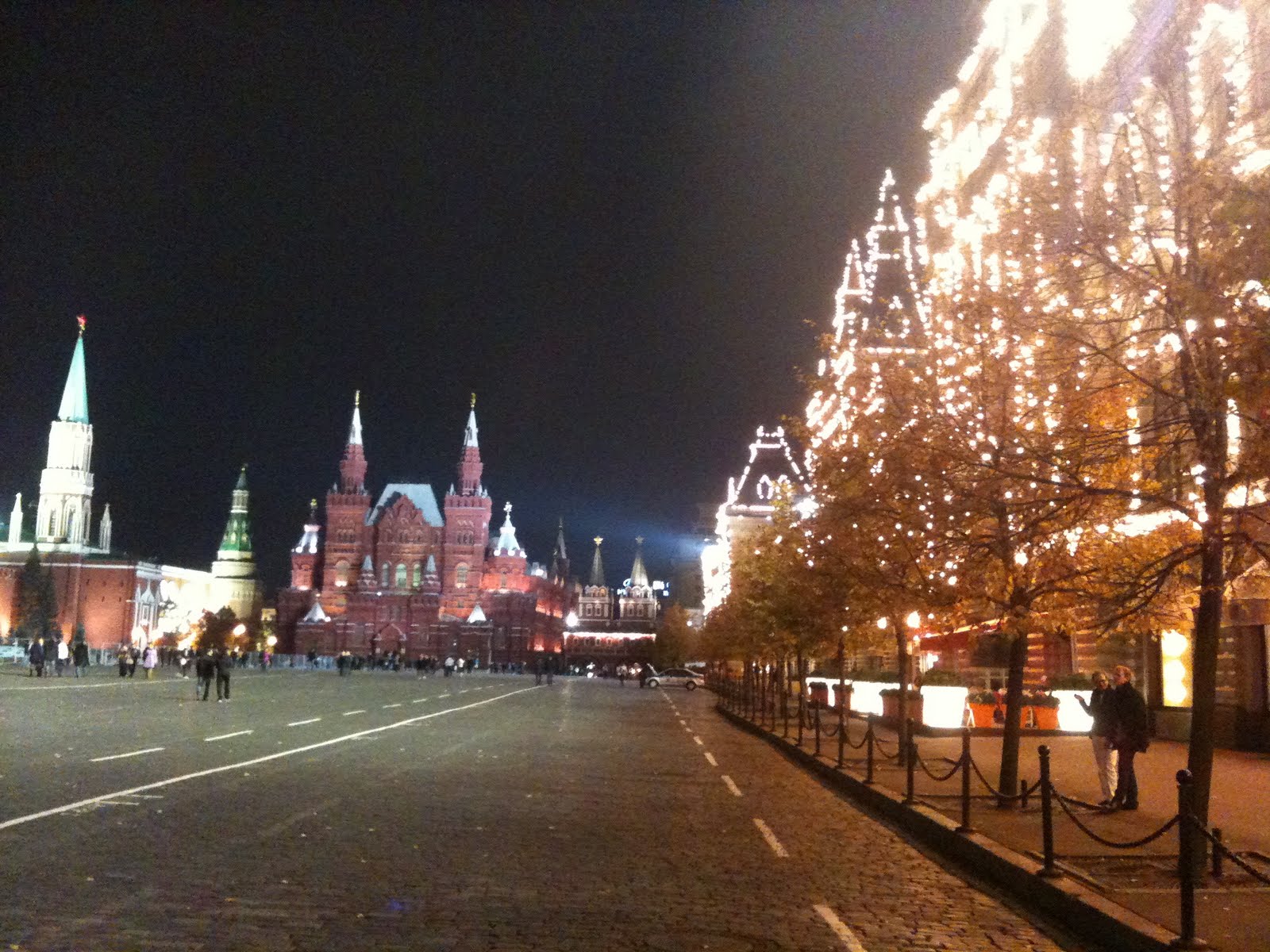
I was out and about last night and decided to take a few pictures of the bright lights of the city:


Occupy Wall St.
I'm sad that, by chance, I left the country just at the moment this was getting started. I'm now consuming news and information about it on a daily--sometimes hourly--basis. Suffice it to say, no one is likely to start an "Occupy the Kremlin" movement any time soon.
If you're out there in 'Merica, find a site--NYC or one closer to home--and please go. Check it out.
If you're out there in 'Merica, find a site--NYC or one closer to home--and please go. Check it out.
Friday, October 07, 2011
Crappy Opinion Pieces, a Global Phenomenon
I was reading Moscow's English-language newspaper the other day and happened across this:
American Terrorist Liberties Union
I'll give you two guesses, based only on the title, what the thrust of the author's opinion is. And the staggering thing is that she is affiliated with what is ostensibly a moderate to liberal media outlet, Ekho Moskvy. In this case, that could not stand in the way of a good game of "beat-the-hippie."
I'm angry about the "world is black and white, good guys and bad guys" worldview not so much implicit ans explicit in the article. Far too reminiscent of George W. "You're either with us or against us" Bush.
The first person I showed this to brought it to my attention that her interpretation of Harry Potter is even wrong. (Full disclosure, I did not read past the first book. Знаю, что я - некультурный человек.)
Any other thoughts on this?
By the way, I sent a response to the Moscow Times editorial page, but I highly doubt it will get published. I've not heard anything back from them.
American Terrorist Liberties Union
I'll give you two guesses, based only on the title, what the thrust of the author's opinion is. And the staggering thing is that she is affiliated with what is ostensibly a moderate to liberal media outlet, Ekho Moskvy. In this case, that could not stand in the way of a good game of "beat-the-hippie."
I'm angry about the "world is black and white, good guys and bad guys" worldview not so much implicit ans explicit in the article. Far too reminiscent of George W. "You're either with us or against us" Bush.
The first person I showed this to brought it to my attention that her interpretation of Harry Potter is even wrong. (Full disclosure, I did not read past the first book. Знаю, что я - некультурный человек.)
Any other thoughts on this?
By the way, I sent a response to the Moscow Times editorial page, but I highly doubt it will get published. I've not heard anything back from them.
Thursday, October 06, 2011

Thursday, September 29, 2011
 Moscow is a huge city. And I do mean huge, in terms of both population and physical size. I read on Wikipedia (so it must be true!) that Moscow is the northern-most city in the world with over 10 million people. In fact, it has about twelve million official residents and, by some estimates, another 3 million unofficial ones. That's 15 million. 15,000,000. It also has a land area of over 400 sq. miles, making it a little more than 1/3 the size of the state of Rhode Island. Or, for you Euro-philes out there, about half the area of Luxembourg.
And so I had to prove that, amidst all of this hustle and bustle, there are some green spaces. Like the one above, at Chistye Prudy (lit. Clean Ponds).
 In need of a chance to stretch my legs, I decided to walk home from Chistye Prudy, following the Boulevard Ring. Like most European cities of a certain age, Moscow is constructed on a series of rings. For the most part, these follow the paths of defunct city walls. In Moscow, the inner of these two follows a the site of walls that were taken town in the 18th century, having lost their value after being replaced by a large set of earthworks where now the outer Garden Ring courses. The boulevards themselves became permanent features during the reconstruction after the city was destroyed by fire in 1812.
The picture above was taken facing downhill on Sretenskii bul'var, in the direction of Tsvetnoi bul'var.
 A little further along, you eventually come back around to Tverskaia, the major thoroughfare of central Moscow. In the square where they meet, a fountain, which at that time of the afternoon happened to be well lit.
 Did I mention that the square is named after everyone's favorite Russian poet? I couldn't resist taking this picture of the pigeon roosting on the head of Aleksandr Sergeevich, milyi.
Tuesday, September 27, 2011
Work?
The last two days have been my first two doing, well, what I actually came to Russia to do: work in the archives. Rome was not built in a day, and neither will my dissertation be researched in two. In fact, I won't even get a chance to see any documents until Thursday. No matter, it's an accomplishment just to get in, get set up, get the proper passes, and fill out the necessary paperwork. So while I have no pretty pictures to show for them (more of those soon, I promise), it's been a good couple of days.
In other news, I've also gotten my registration (hooray legal residency!) and therefore have been able to buy a SIM card. Now I can make phone calls, like an adult!
In other news, I've also gotten my registration (hooray legal residency!) and therefore have been able to buy a SIM card. Now I can make phone calls, like an adult!
Sunday, September 25, 2011
Weekend Fare
 As promised, a few pictures of food: this is the leek and potato soup I made with the aid of my trusty dutch oven. It is, in my opinion, the best ten pounds I could have put in my luggage. Or at the very least, the ten pounds that will help me eat better this year! There wasn't a whole lot to the recipe. Basically, just remember to wash the leeks thoroughly, sauté them along with your carrots and celery. I added a bit of garlic for fun. Then in go the potatoes and stock. Leave it at a slow simmer until the potatoes are soft, probably 30 min. or so. Finish it with a bit of cream, or not, as you so desire. Just that easy!
 And what weekend would be complete without some time spent in a coffee shop? There are not many places in Moscow with chairs as comfortable or an atmosphere as good as Coffee Bean. I have time, so I will keep hunting them out.

Saturday, September 24, 2011
The Environs
 As promised, I snapped some pictures of the immediate neighborhood around my apartment and of my building. This first one is of ulitsa Krasina (Krasin street). It might have been named after this guy: Leonid Borisovich. But since he apparently was disgraced after his death, perhaps not.
In any event, I took this picture on my way to the supermarket, which is fortunately about 2-3 minutes walk away from home. It's not a very wide street, but as you can tell, it's comparatively busy.
 This is the outside of the building. As I said in my last post, it doesn't face the street, so you have to know where you are going to find it. I think you should be able to make out the signs on the corner of the building that show the street name and number. It's a gray brick building, a pretty standard five-story apartment block. Since it doesn't appear to have been prefabricated, my guess is that it was built sometime in the immediate postwar period--no later than 1955.
 This is the door to our entrance, no. 1 of 2. It's the first line of "defense," if you will. The first of several. There is an intercom over which to call any of the ten apartments reached from this entrance, but for residents, there is radio-frequency gadget that one keeps on a key ring. Just swipe it and in you go. Then inside of that is another door, locked with a push-button combination. And that only gets you to the stairwell . . .
 . . . which looks like this. That's our door at the top. Two more doors here, each one with it's own key. Isn't this fun?!
Perhaps next time some pictures of some of the other things in the neighborhood. Stay tuned!
ul. Krasina 24, ap. 10
 In an attempt to show my loyal reader(s) a little bit more about my new-found life in Moscow, I snapped a few pictures of my apartment. This is the first of a multi-part series: I will try to post pictures of my building and neighborhood in the next few days.
The apartment has three bedrooms and is located on the fifth floor of a five-story building. Sorry, no elevator. On the bright side, I won't be in the market for a second-hand Stairmaster.
 When you enter the apartment--through the typical double doors--my apartment mates' rooms are on the right, and to the left is the common area. It has a TV (I don't actually know how many channels we get. I haven't even turned it on!), coffee table, and couch.
 Again to your left, beyond the couch, is the kitchen. It is, for kitchens in Russia, large and well apportioned. In fact, it's better than those of many of my rental places in the States (but not Todd St.!). Note the bookshelf in the foreground. It is, in addition to my contributions (the most recent New Yorker and Graham Greene's The Quiet American), well stocked with Russian fashion magazines. Perhaps I will browse them over breakfast. Let's call it "cultural research."
 One of the advantages to living in a country awash in oil and gas: gas stove. I had forgotten just how awesome cooking with gas is. Hooray! There will be future posts about cooking successes and follies. Sneak peek: on Thursday, I made a potato and leek soup with cream. Yum!
 The view from my room into the common area.
 My room, which includes a large desk by the window and more cabinet space than I could possibly use. In addition to those in this picture, the entire wall behind me is covered with similar cabinets. Whoever remodeled this room seems to have knocked over an IKEA. And I can't complain.
 There is also a balcony which leads from the common room. The view isn't much, but that's because our neighborhood is relatively quiet and the building is screened even from the local streets by other buildings. The sound is the soft hum of busy streets--Tverskaya-Yamskaya and Sadovaya--that are 3-4 blocks away. This is the view as you look left, in the direction of M. Mayakovskaya. It's a little scary that the maple in the foreground has lost almost all of its leaves. Not all the trees are that far gone, but fall is in full force. On a happier note, there is a beautiful goldfinch in the tree at this moment. It's the little things.
 This is the view as you look right. The building in the foreground is a secondary school.
 A closeup over the top of the school, that is the top of the Stalin-era "skyscraper" at Kudrinskaya ploshchad'. You can check out more about it and it's six contemporaries on their collective Wikipedia page.
Thursday, September 22, 2011
"Don't talk to strangers . . ."
As many of you may know, perhaps my favorite work of Russian literature is Mikhail Bulgakov's masterpiece satirizing life in 1930s Moscow, The Master and Margarita. It turns out that the actual location of the novel's first scene, Patriarch's Ponds, is located about five minutes' walk from my new apartment. On my way out today to take care of some errands, I stopped to snap a couple of pictures.
This is especially fun since my favorite book people are in the process of reading the novel. This one's for you!

Malaia Bronnaia street, which is one of the four that ring the park.

One side of the pond. Also, a puzzle: in Russian it is "Ponds," but there is only one pond. My guess is that there used to be more, but as the Patriarch's estate became incorporated into the growing city, they were filled in.

And finally, a bench, close to the entrance, with it's back to Malaia Bronnaia. Perhaps the one that Bezdomnyi, Berlioz, and Woland occupied?
In lieu of update, a pretty picture
Mission #1 largely successful: I went to bed at 10 pm local and woke up at 8:30 am. I'm sure I will be tired, but at least I seem to have beaten jet-lag. (Knocks wood.)
Since today and the next few days will probably be taken up largely with getting settled and taking care of bureaucratic stuff, all I can do is post a pretty picture I took out the window of the airplane shortly after leaving JFK yesterday (?) the day before yesterday (?).

Since today and the next few days will probably be taken up largely with getting settled and taking care of bureaucratic stuff, all I can do is post a pretty picture I took out the window of the airplane shortly after leaving JFK yesterday (?) the day before yesterday (?).

Subscribe to:
Posts (Atom)